1 March 2013: One More Time .. As The New GM Goes, As KOBE Steel Goes, and As Gold Goes …. So Goes The Dysequilibrium Saturated Asset-Debt Macroeconomic System

… As The New GM Goes, As KOBE Steel Goes, and As Gold Goes …. So Goes The Saturated Global  Asset-Debt Macroeconomic System

The Asset-Debt Macroeconomic System is composed of two major classes of assets: tangible and intangible assets. This is the 2008 breakdown for the US.
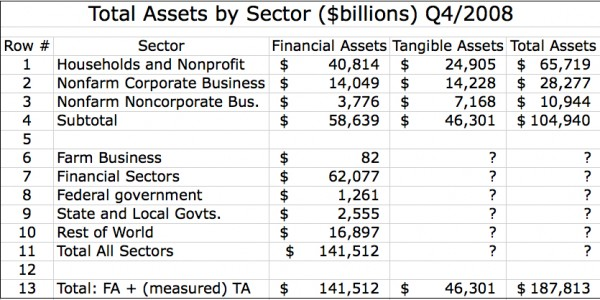
Included in the 2008  US 46 T Asset-Debt System’s tangible hard assets are the M2 money supply,  factories, machinery, real estate, automobiles, energy plants, water treatment systems, electrical grid hardware and software, communication systems, military hardware, TV’s, fiber-optic cable system’s, cell phone towers, satellites, cell phones, minerals, precious metals, kitchen sinks, et. al.

Some of the tangible assets: nuclear weapons, satellite systems, delivery systems, and communication systems, which represent a very small amount of total value of the system are worth relatively  much much more in terms of the maintenance of the current form of the Asset Debt system.

The Asset Debt systems intangible assets exist in some form of IOU where the intangible can be traded for and redenominated in hard currency or tangible assets.

There are two types of the IOU intangible elements: type 1: “real and existing” and are more easy to redenominate in hard currency and type II: “virtual counterparty agreements” which are much more difficult and more lengthy to settle.

The type I intangible asset has already been ‘earned’.  M2 equivalent money  has been traded for a derivative of a class asset; equities or commodity futures, or for debt instrument and is undergoing storage.

The storage site owes the “earned and existing intangible Type 1 asset” to its owner and acts as a trader medium to convert the asset into a M2 equivalent hard asset.

Tax laws and system leverage regulations skew M2 equivalent money flow entry into the various Type I intangible elements.

The Type II intangible asset has a  virtual quality in that it only conditionally exists if the following counterparty agreement below is successively fulfilled. i

This  agreement is the exchange of future earnings/tangible collateral/intangible collateral traded against the current use of existing tangible assets ,i.e., M2  often used to purchase tangible assets.

Use of ‘existing and earned’ tangible money becomes caricatured via the private banking system.  The private central bank system and fractional bank lending allows adequate leverage in the system to expand a 10.5 trillion dollar base to 55 trillion of total US debt.

In a manner even the type 1 ‘earned and existing’ intangible assets have type 2 characteristics which are dependent of the viability of the trader medium and the timed based intangible asset class  valuation saturation curves.

After consumer saturation with debt and overvalued assets in the 15.5 trillion base GDP and  after peak equity population involvement,  owners of stock market intangibles can expect nonlinear collapse in M-2 equivalent  returns.

Review the estimated 2008 188 trillion US Tangible/Intangible Asset grid again.

And more recent data on Intangible asset growth by 2010
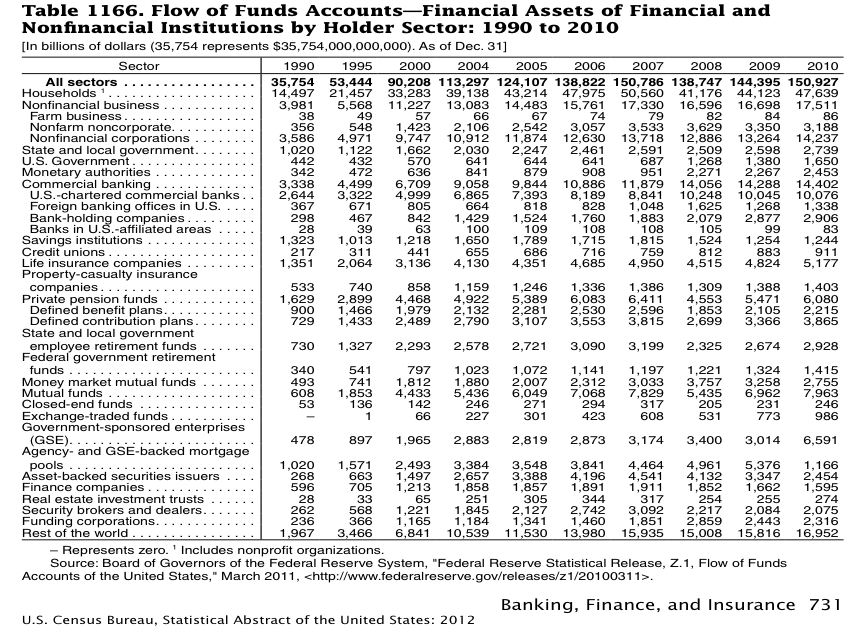
In December 2012 the Federal Reserve announced a 1.7 T dollar increase over 3 months in household and nonprofit total worth to 64.8 T still about a trillion dollars less than 4th quarter 2008. (see above tables.)

For 2013 a rough estimate of the breakdown of the US 200 trillion worth within the one quadrillion World Asset debt Macroeconomy is:

Tangible assets including the M-2 10.5 trillion money supply: 45 trillion or less (with the collapse of 2008 real estate prices)

Intangible Asset items : 1. total a) US Local ,State,  Federal, b) private citizen, C)corporate, and d) financial industry debt 55T, 2. total US equity valuation 16T, 3. foreign equities 2T, commodities .5T 5. total holding of foreign state and corporate bonds 2T = 75trillion.

It doesn’t seem that the total intangible asset valuations that the official US tables delineate  add  to the probable 170 T (150T in 2010).

Where are the additional 95 trillion of the US financial intangible assets listed in the 2010 table and in what form are they?

And the 55 trillion in debt is leveraged and derived from a 10.5 trillion 2013 M2 base and 15.5 T a year US economy which has been supported by 600 billion year ex nihlio money creation from the US private central bank for the last four years ….

Something is clearly amiss.

This US asset debt system is excessively leveraged with 150 trillion worth of combined debt and financial intangible assets dependent on a 15.5 trillion annual GDP , a 10.5T dollar money base, and a debt saturated, overvalued-asset over-consumed consumer citizen population within that 15.5 T operating GDP economy.

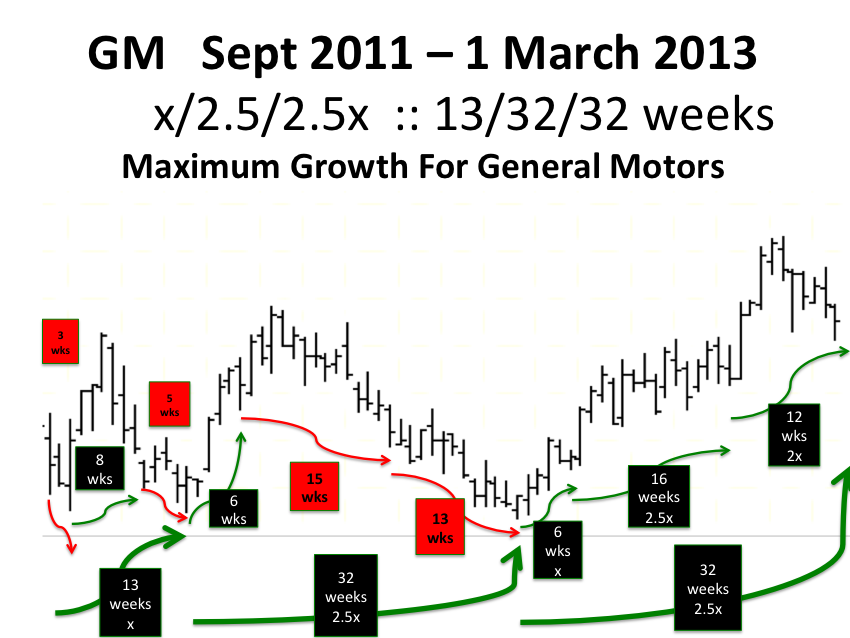
As GM  Goes:                                                                                            So goes deflationary collapse….                                                         Maximum growth: 13/32/32 weeks as of  the week ending 1 March 2013
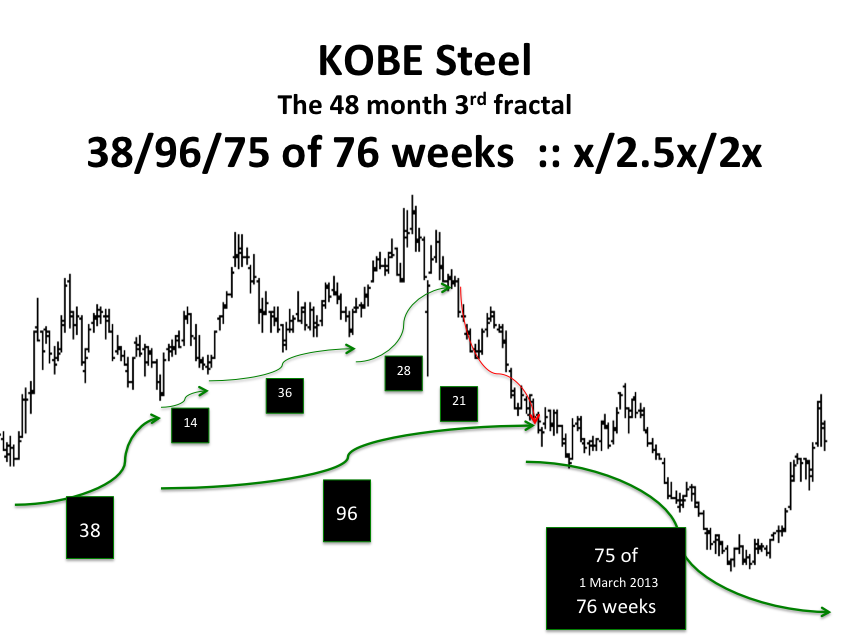
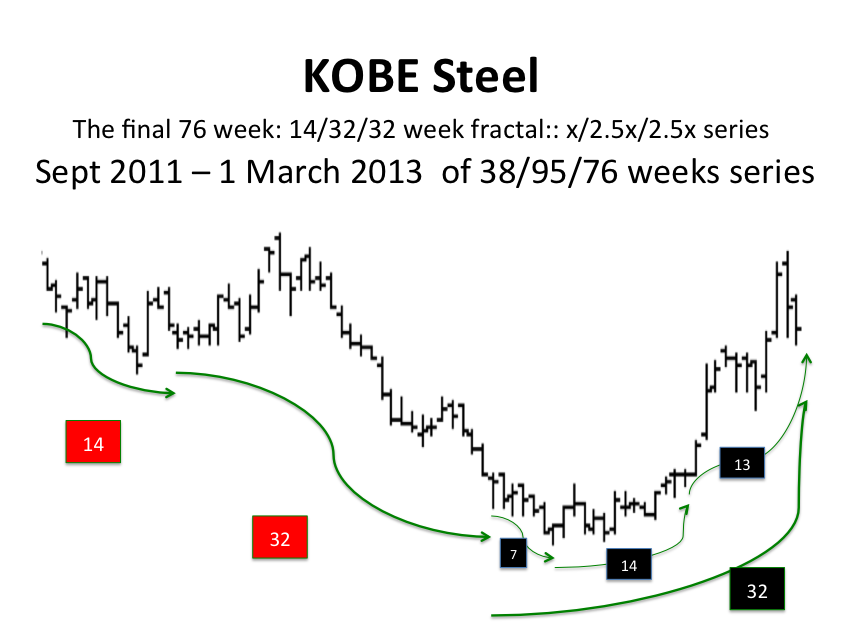
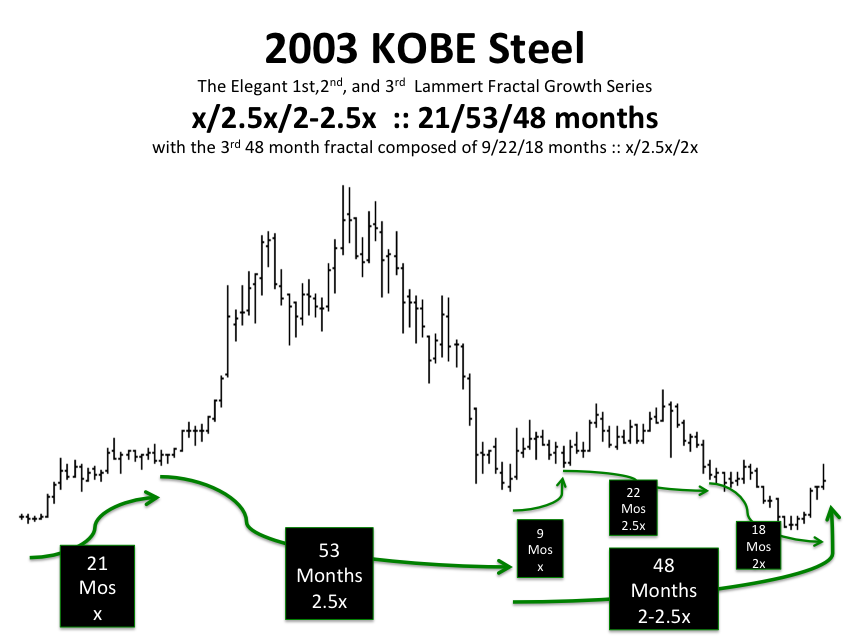
                                                                                                                   As KOBE Steel Goes…                                                                            so goes the real hard asset steel girder use and macrobuilding growth in the global economy  ….
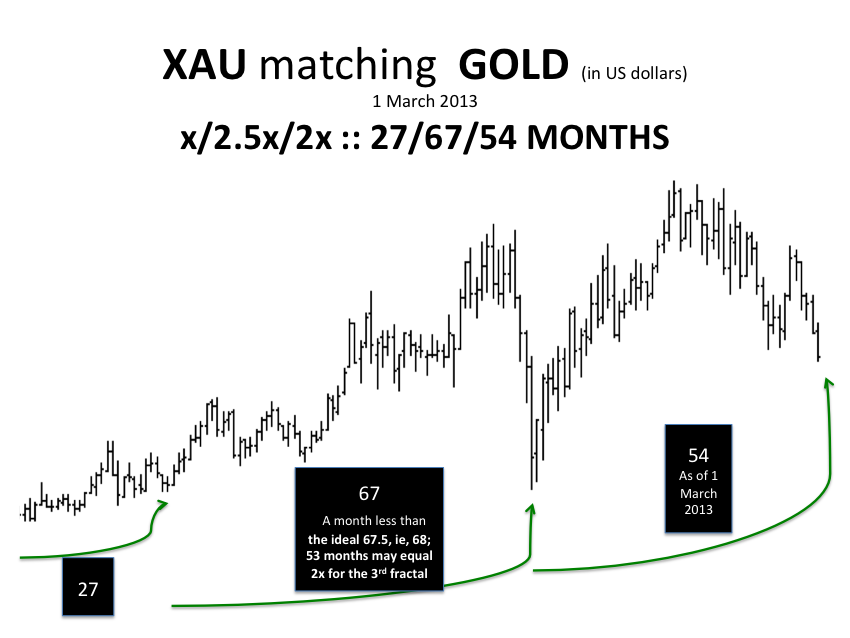
As Gold Goes ….                                                                             Asset-Debt Macroeconomic System deterministic self assembly deflation and collapse goes… … And the Hegemonic US dollar and Hegemonic  US bond futures go oppositely in valuation ascent. But gold is but one of many asset carts and the Asset Debt macroeconomic system is the horse.


The Patterned Science of Global Asset Debt Saturation Macroeconomics: The Long Term 1988 and Short Term 2003 Nikkei, The 1993 and 2000 Gold, and The 2007 US Ten Year Futures Quantum Fractal Saturation Curves

The Nikkei, Gold, and US Hegemonic Ten Year Futures

Towards a  Naturally Progressing Deterministic Quantitively Understandable Global Asset-Debt Macroeconomic System

In the last posting, a qualitative explanation was provided to understand the current time window of the self assembly global macroeconomic system. The disparity between the rate of US debt creation and the rate of GDP increase to service the debt was reviewed.  From 1980 to 2012 US GDP increased from 2.4 to 15.5 trillion dollars about 650%, while total debt increased from 4.8 to 55 trillion or 1200%.

About 1/4 of the US total 200T asset worth is debt: 55T. Debt as an asset  provides the countervailing counterbalancing linkage to the entire system. Too much debt via leverage or low interest can be produced. Asset can be overproduced and overvalued based o debt leverage and interest rates. If the system does not produce jobs and earnings at its base debt will undergo default, the collateral asset will be assumed by the owner of the debt, placed on the market and, in saturated asset  overproduced environment, a resulting  lower valuation. If there is no real collateral, college loans and asset derivatives, the owner the debt may receive nothing from the counterparty.

In this counterbalancing manner,the Asset-Debt  Macroeconomic System proceeds in a highly organized mathematical self-correcting progression.

With the US dollar as the world’s reserve currency, 55 trillion of debt against a 15.5 T dollar GDP economy, a smaller  work force, and less demand, the system’s will create lower interest rates, which will further deplete the able debtor citizen population.

Even in the 1930’s depression US interest rates have never been this low. This level of low interest rates are an anomaly in terms of the 225 year of the US economic activity but are an expected nonlinear part of the patterned  Science of Asset-Debt  Saturation Macroeconomics.

And the Asset-Debt System ‘requires’ that  US interest rates  go lower -much lower.   This is the time area of a US 1858 Second Fractal Asset-Debt Macroeconomic System Collapse.


The Nikkei, Gold, and US Ten Year Note Fractals:

Remembering that this is a global one quadrillion total wealth asset-debt Macroeconomic system, the combined worth of the three assets element below represent less than 2.5 percent of the global total asset-debt wealth.

The NIKKEI: The Nikkei peaked on 29 December 1989 at 38957. On 6 February 2013 it reach a 4 year new peak valuation of 11498, about 27 percent of 23 year earlier peak. Euphoria abounds.

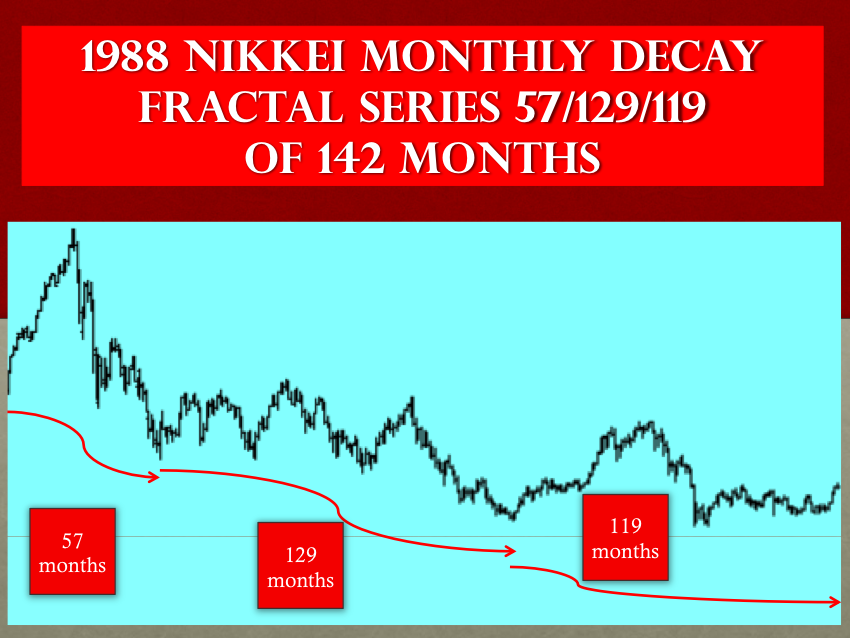
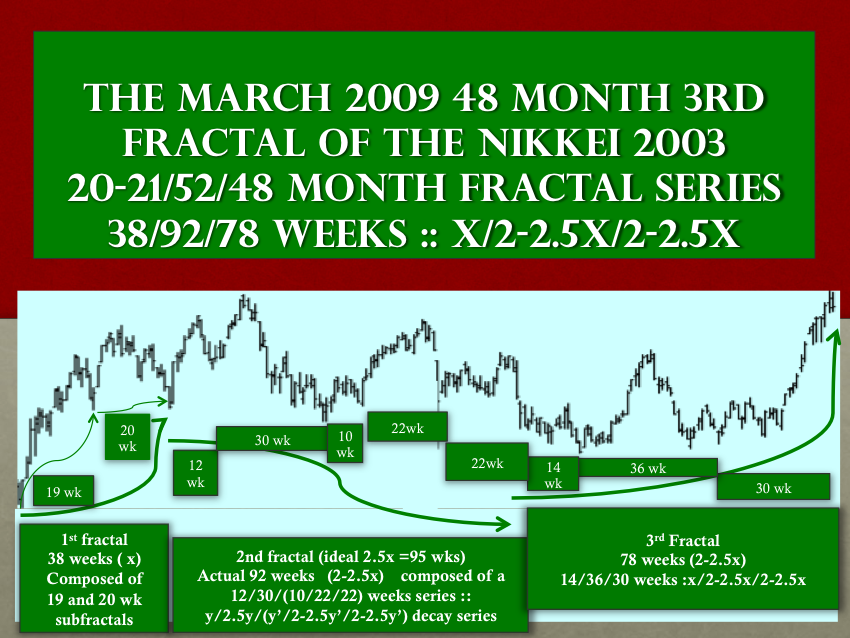
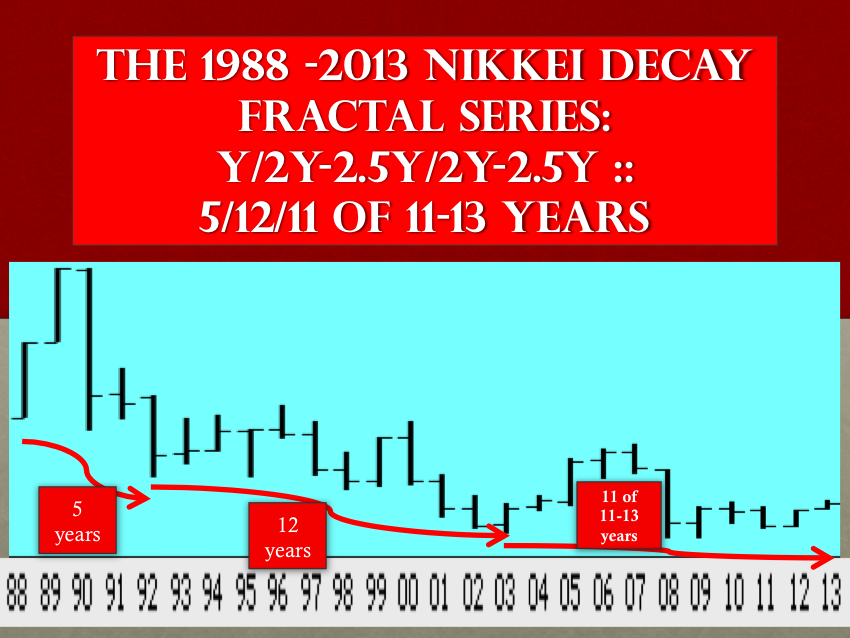
The 1988 Nikkei  y/2-2.5y/2-2.5y  ::  57/129/119 of 143 Monthly Decay Pattern

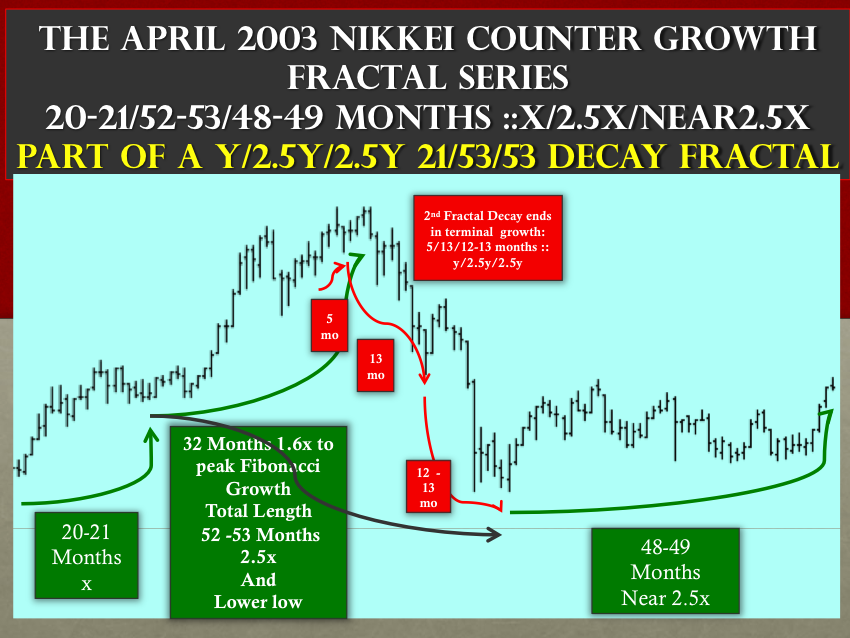
The 2003 Nikkei: x/2.5x/2-2.5x :: 21/52/48 months or 119 months within the 1988 3rd fractal 2-2.5y 114-143 month  Decay Pattern.


GOLD: The internet bubble’s mid and late 90’s perturbation on the 1932 to 2013 Gold Valued in US dollar’s Quantum Saturation Curve  Pattern

1993 to Feb 2013 Gold: 45/103/93 month : curvilinear blow-off fractal.                             The competing internet bubble sucked speculative dollars from the gold market; the internet malinvestment bubbles’ collapse sucked further speculative dollars with a basing in 2000

Early 1993 first base fractal 7/17/14/10 months or 45 months                                                       End of 1996 second fractal  15/38/30/23 months or 103 months curvilinear                                           Mid 2005 third fractal 42/53 months or 94 months

From 1932 Gold’s valuation indollars followed the CRB’s 8/20/10 year pattern.  1960 to 1970 formed Gold’s 10 year base fractal with a 1970 to 1993 (7+/18 year) or 24 year second fractal. The third is composed of the 1993 curvilinear 45/102/94 month or 4/10/8 year or 20 year fractal. The US 1960 to 2013 Gold fractal in US dollars is 10/24/20 years :: x/2.5x/2x.

Even with low interest rates, defaulting debt and collapsing asset prices will cause a drop in gold valued in US dollars to  300-400 dollars.

Against the valuation of gold dominated in dollars, the US dollar has began the steep part of its valuation growth curve against other currencies with its first 42 month base fractal from 2008 to 2011 and the 3/8/6/5 month Lammert: x/2.5x/2x/1.6x  19 month  first subfractal of the second fractal growth series completed on 1 February 2013.

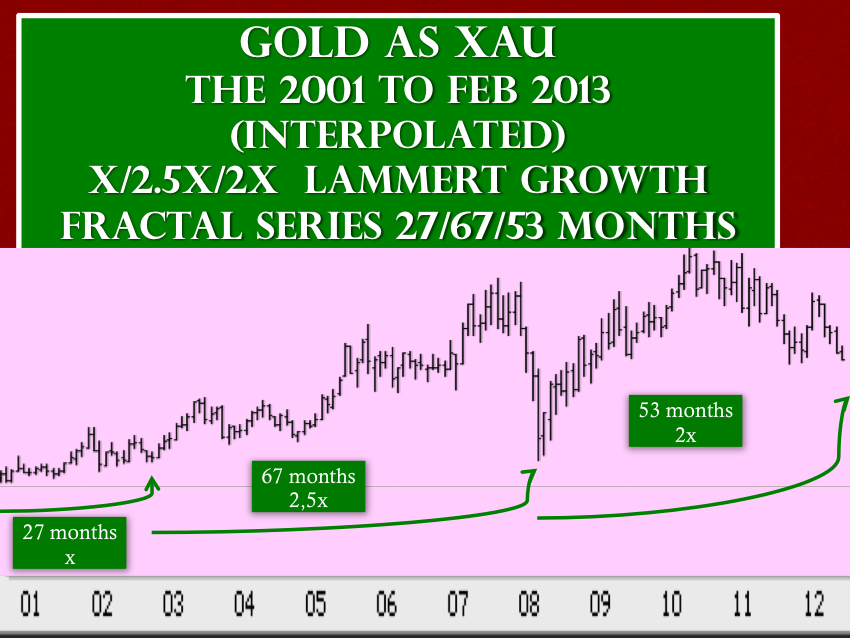
An interpolated Gold  fractal began at the low in US dollars in 2001 follows a 27/67/53 month Lammert growth pattern :: x/2.5x/2x and representing maximal growth.

US TEN YEAR NOTE FUTURES

During Asset-Debt system global collapse, Ten Year US Notes along with the US dollar will gain in value against other defaulting debt and declining in value lower quality currencies. US interest rates will reach 150 year historical lows.

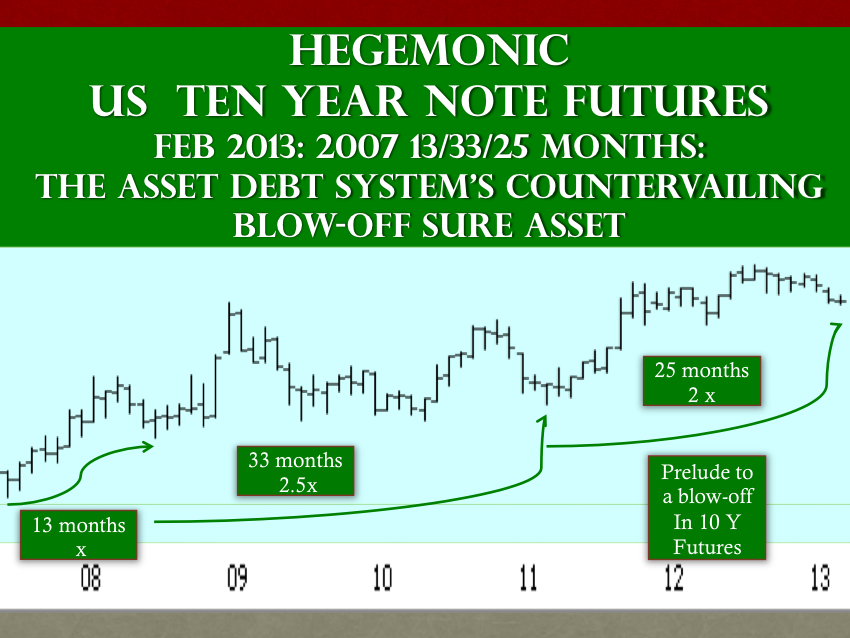
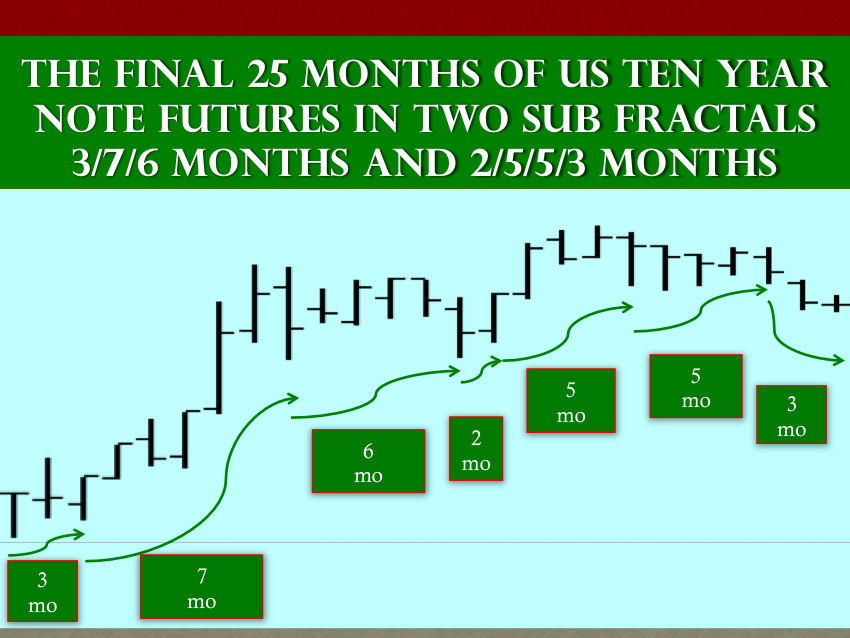
The US Ten Year Futures have been a conundrum in terms of the last 25 months of a 13/33/25 of 26-33 blow-off.  This conundrum has recently been solved showing that the 25 months have occurred in two subfractals with the oppositional and tax advantaged US equities having a favored speculative population with exhaustion of that population at the extreme of the 26 month (2x) US Ten Year Future’s Note Blow-off Third Fractal.


The Real Citizen Economy Verses the Wall Street Central Banker Derivative Equity ZIRP Bubble Economy: Toward A Qualitative Understanding of The Global Macroeconomic Quantum Asset-Debt System Collapse

The key to having a qualitative wherewithal about the  large scale functioning of the US macroeconomy is understanding that it is, at its consumer citizen foundation, at its 1:1 leveraged foundation,  primarily a forward consumption based system. In the elementary citizen economy, future earnings of private citizens  are the collateral traded against the real time possession/use of assets or services. Homes and automobiles are generally solid collateral.
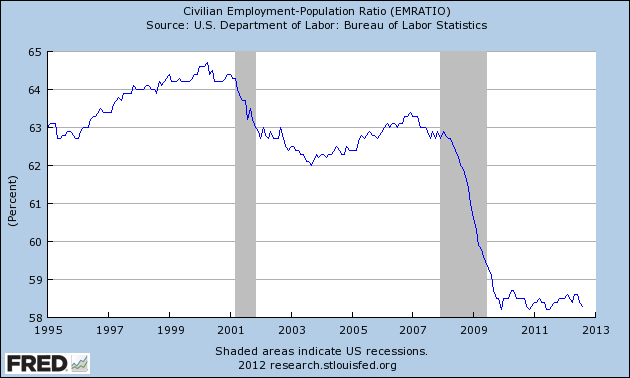
In the financial industry world  colluded with former Fed Chairman (who apparently uses the logic that because the equity market valuations  are leading indicators (they are) of economic activity that if the equities are OK, then the economy is OK) the derivative  leverage is 1:10 1:30 and the collateralize assets are murky and amorphous and when the leverage  causes extreme Asset-Debt excessive forward consumption, debtor population depletion, overproduction, and overvaluation, collapse occurs with the above FRED chart consequences.
What are the limitations in the asset-debt macroeconomic system  caused by the total US accumulative debt vice concurrent GDP growth on further citizen based and business based forward consumption growth?  A  look at a window of  5 year periods of history since 1980 of US debt growth cumulativelly relative to GDP growth which services the debt may be  instructive.
The total US debt and GDP growth is in trillions of  same year US dollars.
  Total Accumulative US Debt in 5 year increments in same year dollars

19-                 80       85       90      95   20- 00      05      08      10       12                              Total                                                                                                                                    Debt(T)         4.8      8.6     13.6   18.7     27.2   42.1    53.2    53.2     55.4

%5yr   delta(D)                                                                                08-12D    
 debt growth           80       60       40        50       50               25       03

 US GDP  by 5 year increments in same year dollars(2008 bubble peak included)   1977 to 1985 to 1997 represented doubling of US GDP in same year dollars

 2Q19-       77   80     85      90     95   97   00      05      08      10       12
US GDP
year $(T)   2.1  2.4   4.2     5.8     7.3  8.4  9.8     12.3    14.4  14.4    15.5
Notice that since 1980, total US Debt in same year dollars has increased 1150% while Total GDP has increased by only 600% and with a smaller base 2.4 vice 4.8T.  While total US debt doubled by about 27T from 2000 to 2008, total GDP increased by only 40% and with a smaller base – by only 4.6T: a 4.6T GDP increase to cover 27 trillion of new debt. Since 2008 total debt has increased by 2T while GDP has increased by 1.1T using the 2Q 2012 as an annual average.
It could be explained that all of the new 1.1T GDP increase in the last 4 years was dependent on ‘QE’ black box, a euphemism for the Central Bank placing 2.5T on its books to keep the real economy alive. Nearly all of this QE money could be considered defacto  as paid out directly in the form of  SS checks, medicare payments, military checks, defense contractor jobs, federal employee salaries, welfare checks, et. al.  supporting directly the real citizen economy.

Otherwise considered,  1% of the interest on the  50T  represents 500 billion. This is about the same amount that the Central Bank’s QE program’s have been lending per year to Congress to continue to fund a non-sequestered,  central bank-maintained,  asymptotically-saturated asset-debt macroeconomy.

The citizens benefit by continued employment and obviously the elite creditors and owner’s of the 50T of debt benefit by continued payment. Concern for the US Bond rating is identical to the concern of honoring the Elite’s 50T of debt assets.

And otherwise considered, all of the net US tiny 3 percent debt growth from 2008 to 2013  could be attributed to congressional incurred debt and the Central Bank’s exhilo creation on their books of 2.5 trillion dollars and likely other  zero sum currency/bond exchanges with other central banks.

This exhihilo creation of money happened because mathematically it had to happen.
System interest rates cannot increase appreciably because the saturated asset-debt macroeconomic system mathematically can not allow it and can not pay it.

Sequestration will not happen because the asset debt system mathematically will not allow the US politicians allow it to happen.

Can the citizen consumer based forward consumption economy grow itself out of this 50 T dollar of system debt – all of which is based ultimately a real citizen consumer economy.

Look at the 1980 numbers the 2008 peak numbers and Q3 2012 numbers of US relative group debt.

Cumulative and Individual group debt.

1980           2008               Q3 2012

Total(T)                        4.8               53   (10x)           55
Congressional S/F      1.1               9.3    (9x)          14.3

Citizen                         1.4             13.7    (9x)          12.9

Corporate                    1.5             11.5    (8x)          12.1

Financial Industry        0.6             17.1    30x)         13.8

Foreign                        0.2              1.7     (9x)            2.3

Who are the counterparties to this debt? Who owns the 55 trillion dollars of obligation?  Those who would like continued interest payments on the principal.

Is the math possible for the real citizen based US GDP 15-16T economy to grow itself out of the shadow of the growth of US’s 1980 4.8T total debt, and, in particular, the Financial  Industry’s bubble contribution, to the 1150 increase in US total debt to the 2012  55T, while the US economy’s GDP in same year dollars has increased from 4.8T in 1980 by only 600%  now at 15.5T in 2012.

And here is the answer, the rub, the paradox, the saturation asymptote of the citizen-based forward consumption Asset-Debt Macroeconomic System ….

… in a forward based citizen consumer economy the only way to grow  the economy is to increase the citizen debt load (or congressional debt load) by further borrowing against future earnings.

That consumer borrowing population is simply depleted…

Even with Central Bank QE assistance, the necessary solution to this asset-debt system conundrum is partial debt default and asset devaluation. 

Part of the default at some point in the future, will be the erasure, the debt jubilee on the Central Bank’s black box holdings.  For those who  think the Federal Reserve’s 500 billion per annum QE action will result in inflation, think of the 55 T total debt sink sucking 500 billion, 1 trillion, 1.5T, 2T dollars out of the system each year at 1,2,3 and 4 per cent interest rates.

In the next weeks and months as the asset-debt system mathematically implodes , the above qualitative information may frame a basis for a better understanding about what is happening.

The Pattern Science of The Asset Debt Macroeconomic System

It is, however, in the asset-debt system’s exquisitely precise  time based quantum valuation saturation curves of the US composite equity, east and west major nation composite equity, and commodity asset classes and, oppositionally, the countervailing US hegemonic debt futures and yes the rising US dollar where the footprints of Asset-Debt Saturation Macroeconomics can easily be observed demonstrating a highly organized quantum pattern of the system’s weaker assets’ devaluations – as bad debt which can not be mathematically repaid in a consumer job-earnings collateral forward based and asset saturated economy – undergoes necessary and inevitable default.


Non-Stochastic Saturation Macroeconomics