The US Asset-Debt Macroeconomic 1807 36/90/90/54 Year Great Fractal Cycle

The Asset-Debt Macroeconomic system’s 1807 US hegemonic 36/90/90/54 year :: Great Fractal Cycle

  1. The Efficient Market Saturation Time-based Trading to Peak and Nadir Valuation Theory of Quantitative Fractal Valuation progression:

The central banks expand and contract available system debt/money to sustain the asset-debt macroeconomic system with the bank’s defined boundary conditions of 1. unacceptable unemployment vice 2. unacceptable consumer inflation (and likely unacceptable consumer asset devaluation). The asset-debt macroeconomic system then integrates  the central bank’s manipulation of credit/money expansion/contraction via interest rates and broader measures of  QE/QT  and self-orders and self-assembles asset valuations into the most efficient time-based mathematical trading saturation growth-to-peak valuation fractals, and trading saturation decay-to-nadir valuation fractals. Within major valuation growth trends there is periodic countertrend decay  and vice-versa. These time-based saturation trading valuation fractals are seen on minutely, hourly, daily, weekly, monthly, and yearly unit scales. 

2. Two simple self-ordering asset valuation time-based fractal patterns represent the most efficient pathways to trading saturation peak valuations and nadir valuations. These recurrent fractals pathways confer upon the complex macroeconomic asset-debt system the characteristics of a patterned science. The two time-based fractal patterns are:

An ‘A’ type 4-phase fractal series : xy/2-2.5xy/2-2.5xy/1.5xy (the fourth subfractal unit ranges from 1.4xy to 1.6xy)

First xy subfractal unit: time length defined by nadir to nadir  point time  trading saturation valuations

Second 2-2.5xy subfractal unit: time length defined  by nadir to point time nadir trading saturation valuation with a nonlinear lower low drop occurring between the 2x to 2.5x time frame

Third 2-2.5xy subfractal unit: time length  defined by concluding Second subfractal point time nadir valuation to final point time peak valuation trading saturation

Fourth 1.5xy subfractal unittime length defined by point time  third subunit peak valuation  to point time nadir trading saturation valuation

and 

a ‘B’ type 3-phase fractal series: xy/2-2.5xy/1.5-2.5xy.  

The first, second, and third subfractal units of the 3-phase fractal pattern are all defined by the time length defined by nadir to nadir  point time  trading saturation valuations

Observational Empirical examples of ‘A’, the 4-phase series

Yearly Fractal units: Both the Wilshire and Bitcoin in USD reached a daily average high valuation on 8 November 2021. These high valuations occurred in the 90th year of a US 1807 36/90/90/54 year fractal series with valuations lows in 1842-43, 1932, and an expected low in 2074. 

Monthly Fractal units: starting from the March 2009 low:5/12/10/7 months

Monthly Observational Empirical composite equity valuation examples of ‘B’, the 3-phase series: Sequentially from the ending low trading valuation of the March 2009 4-phase 5/12/10/7 month fractal series: 3/8/6 months, 8/17/16 months, and 11/26/16 months ending in March 2020.  

 Daily observational examples of the ‘B’ type series: from Jan 2020 to March 2020 a 6/15/15 day 3 phase decay fractal series can be observed.

3. Current valuation modelling using the above two self-ordering efficient   laws of of the Asset-Debt system:

Equity Composite Asset class

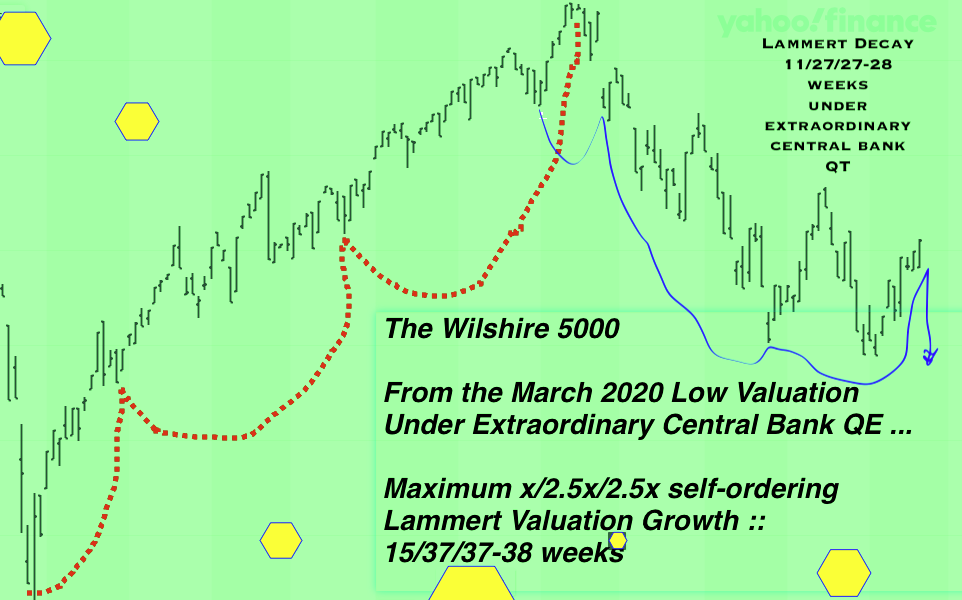
Starting March 2020, a  ‘B’ type 3-phase 8/16/10 of 11-16 month fractal  series is observable. This fractal series is consistent with the timing of central banks’ extraordinary QE response to Covid  and unemployment and later extraordinary QT response to the consumer inflation brought about by QE. The 16 month second subunit contains  the 90th year peak valuation of the 8 November 2021 90 year  third subfractal of the US 1807 36/90/90/54 year  ‘a’ type 4-phase fractal series.

The final 11-16 month decay (8/16/11os 13-16) starts on 24 January 2022 and is  consistent with an evolving  7/15/14/10-11 week (xy/2-2.5xy/2xy/1.5xy) ‘A’ type 4-phase fractal. pattern which corresponds to a 31/73/60-61/47 day fractal series.  The 47 day 4th subfractal series appears to be composed of a 8-9/16 of 20/20 day series with a low valuation expected on Thursday 20 October 2020 followed by a 16 day trending rise to 12 November followed by 4 day nonlinear decline.

US Debt market: (Debt as an Asset)

The US Debt (Debt-as-Asset)Market had  its sharpest 10 and 1/2 month valuation decline dv/dt(squared)  since 1794 

Using the debt market’s inverse parameter: The US Ten Year Notes rise in interest rates (QT) (currently 4.01 %) from 1 August 2022 is  observed to be following  a 11/27/18 of 22/16 days with an expected transient peak interest rate on Thursday 20 October with trending declining interest rates through 12 November 2022.  The current rise in the US Ten Year Note interest rates dates from March 2020 and is following a 7-/16/11 of 13-16 rising interest rate monthly pattern likely part of a  Type A 4 phase 7-/16/13-14/10 month with declining interest rates in the last ten months secondary to a recession.

Quantitative Saturation Macroeconomics: How the Asset-Debt Macroeconomic System Works

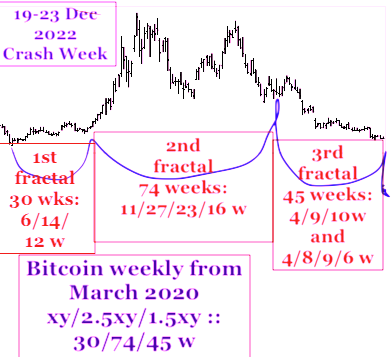
Both the Wilshire and Bitcoin in USD reached a daily average high valuation on 8 November 2021. These high valuations occurred in the 90th year of a US 1807 36/90/90/54 year fractal series with valuations lows in 1842-43, 1932, and an expected low in 2074. 8 Nov 2021 is contained in an interpolated March 2020 8/16/11 month fractal series. (Monthly composite equity valuation fractal series since the March 2009 low have been respectively and sequentially: 5/12/10/7; 3/8/6; 8/17/16; 11/26/16; and currently 8/16/10 of 11-16.)

The central bank expands and contracts debt/money to sustain the asset-debt macroeonomic system with the bank’s defined antipodal boundary conditions of 1. unacceptable unemployment vice 2. unacceptable consumer inflation. The asset-debt macroeconomic system integrates  the central bank’s manipulation of credit/money expansion/contraction and then self-orders and self-assembles asset valuations into the most efficient time-based mathematical trading saturation growth-to-peak valuation fractals, and trading saturation decay-to-nadir valuation fractals. Within major valuation growth trends there is periodic countertrend decay  and vice-versa. These time-based saturation trading valuation fractals are seen on minutely, hourly, daily, weekly, monthly, and yearly unit scales. The system has only two simple self-assembly self-ordered patterns: xy/2-2.5xy/2-2.5xy/1.5xy and xy/2-2.5xy/1.5-2.5xy.  Here xy is used for both possible growth (higher valuation)and possible decay(lower valuation. (The 1807 35/90/90/54 year pattern conforms to the first fractal. pattern as does the initial March 2009 5/12/10/7 month fractal pattern).

The current operative weekly model for this efficient simple self-assembly self-ordering mathematical process dating from 24 January 2022, the start of the final 11 month decay (8/16/11) is consistent with a 7/15/14/10 week (xy/2-2.5xy/2xy/1.5xy) pattern. (using the weekly DJIA or Russel 2000 composite, a nonlinear valuation drop is seen between the 14th and 15th week of the 15 week second subfractal of the 7/15/14/10 week series; this nonlinearity characterizes the terminal 2xy-2.5xy portion of second fractals -see 2005 main page of website).

The final 10 weeks appears to be composed  of a 2/4/4/3 week :: xy/2xy/2xy/1.5xy series. Friday 14 October 2022 would be a low in this simple mathematical fractal model followed by valuation growth to about 8 November 2022 followed by a 3 week significant valuation drop. (The corresponding daily fractal series from 6 September 2022 appears to be 9/21/18/12-13 days.) Grayscale Bitcoin, a proxy for bitcoin in USD is following an interpolated 17 June 2022 17/34/31 of 34 day decay series :: xy/2xy/2xy series (ending 14 October 2022). The historical mismatch of the current 7+% 30 year mortgage rates (22 year highs) and highly inflated residential prices (50 % over two years -2019 to 2021- for existing homes 251K to 377K )has collapsed the pool of potential able buyers. A severe economic contraction is qualitatively predictable. The 8/16/11 money decay fractal series (xy/2xy/1.5xy) is likely to be extended to a 8/16/16 month fractal series (xy/2xy/2xy).

The Terminal March 2020 Third Sub-fractal Great Crash: Starting 24 January 2022:  7/15/14/4 of 10 Weeks :: y/2-2.5y/2y/1.5y  

A lower high peak valuation is expected near  8 November  2022 followed by a 12 day (2/5/5/3) trading day crash 

Contained and mathematically self-assembled within the 1807 36/90/90/54 Year US Great Four Phase Fractal Cyclical Series is the 90th year Third Fractal Cycle Peak Valuation. The interpolated fractal series containing this peak valuation started in March 2020 and is a 8/17/11 month or a 33/66-67/43 week series :: x/2-2.5xy/1.5y.

Specifically, on 8 November 2021, The US Wilshire composite and Bitcoin in USD peaked in simultaneous average day US 90 year Third Fractal high valuations.

To reiterate, for the Wilshire, representative of progenitor US composite commodity and equity stocks, this 8 November 2021 peak valuation date represented the 90th year peak valuation of a maximum US Third Fractal  90 year growth cycle as one of the four cycle subsets of an 1807 36/90/90/54 year four phase cycle with valuation lows in 1842-43 and 1932 and an expected low in 2074. The 8 November 2022 peak valuation was part of an interpolated 8/16/11 month fractal series starting in March 2020. The terminal 11 months beginning 24 January 2022 are composed of a 2/5/4/3 month fractal series equivalent to a 7/15/14/9-10 week fractal series.

Debt and money expansion are created by the asset-debt macroeconomic system’s banks to the capable borrower population to support economic growth involving asset creation and asset development. Before and near the timing of system maximum bank debt-money creation, speculative mis/malallocation of expanded money/debt occurs with asset overvaluations untethered to sustainable prices based on real available wealth related to product and labor-wage growth  at the transactional basic level of the economy.

The asset-debt macroeconomic system efficiently self assembles asset valuation growth and decay, dependent on bank money/debt expansion and alternatively contraction into two discrete fractal patterns :: x/2-2.5x/2-2.5x/1.5x and x/2-2.5x/1.5x-2.5x. Minutely patterns compose hourly patterns which compose weekly patterns which compose monthly patterns which compose yearly patterns – hence the fractal self-assembly nature of the asset-debt system. The large 1807 36/90/90/54 year pattern conforms to the first pattern x/2.5x/2.5x/1.5x. Since the housing bubble global collapse ending in a nadir in March 2009, monthly patterns of 5/12/10/7; 3/8/6; 8/17/16, 11/26/16, and currently 8/16/10 of 11 months are empirically observable – all conforming to the two discrete simple fractal patterns identified at the beginning of this paragraph.

Since 2008, the US central bank has expanded economic activity through extraordinary means with large debt/GDP increases  borrowed from itself and loaned to itself to achieve system stability and resulting in ultra low interest rates. Since March 2020 the central bank’s manipulated low interest rates with additional central bank backed mortgage securities have resulted in system key asset overvaluation derangements. The  average existing US housing prices increased from 250k to 375k during the time period of 2019 to 2021, an unprecedented US market 50 percent valuation inflation.  Rental prices shot up by nearly 20 percent in 2021. When the Federal Reserve realized that its debt expansion policy  to support the economy was the principle cause of socially destructive and unacceptable inflation for the mass US working population, it messaged that it would rapidly reverse its money/debt supply expansion course with historically rapid quantitative tightening. Within 11 months of its messaging,  30 year US mortgage rates are  now at over 7.10 percent and at 22 year high rates.

The asset-debt system is globally interconnecteed.  China’s over-valuation property bubble worth 12-20 times annual wages is imploding, worsened by China’s inability for GDP growth under its central government covid policy. Europe’s industrial output and GDP’s growth will be negatively  and severely impacted  under energy constraints associated with Russian Federation sanctions and Nordstream pipeline disruptions. Significant limitations of global production and distribution of rice and wheat will occur in late 22/2023 as a result of dry weather conditions in China and the ongoing unlawful Ukrainian territory incursion by the Russian Federation.

The last 10 weeks of the 24 January 2022 7/15/14/10 week fractal is likely composed of a 6 September 2020 2/4/4/3 week fractal series correlating to a 9/16 of 21/18-21/12 day series. In this Fractal model a low would be made on 14 October 2022 with a 4 week counter growth cycle ending 8 November 2022 followed by an 12 trading day crash devaluation.

Non-Stochastic Saturation Macroeconomics