The STOXX 600 31 Oct to 5-6 December 2024 5/10 of 11-12/12 days :: x/2-2.5x/2-2.5x 3-phase CRASH Fractal Decay Series

The universe operates by patterned self assembly of its smallest units on the smallest scale to the largest scale with mathematical fractal self-ordering and self-assembly of its subunits, units, and interactive connecting exchange structures.

With energy vibration, the smallest tetrarhedrons of planck side length 1.616 10-35 M may have an averaged bowing length of 1.618: the fibonacci ratio.

Fibonnaci ratio curved (and … with respect to anti leptons and antiquarks – anticurved and … with respect to photons, reciprocating curved-anticurved) self-assembled adjacent tetrahedron groupings form the basis of the universe’s leptons, antileptons, quarks, antiquarks, transfer bosons and – gravity. By fractal matrix math and tetrahedron composite self-assembly in fractal orders of magnitude, the strange tiny world of quantum mechanics is linked to relativity’s macroscopic gravity.

The STOXX 600 does not observe the US (ACWI) Labor Day Holiday and has a 5 August 20241st fractal base length ‘X’ of 25 days. Because 5 Aug starts on the low and ends on the high it is twice counted fractally for a total of 26 days. The expected second fractal 2.5x length is 65 days ending 5-6 December 2024.

The STOXX 600 Fractal Graph is shown below: note the alternating 4-phase and 3-phase Lammert Fractal series that compose the fractal subunits of the 5 August 26/65 day :: x/2.5x first and second fractal series. A 65-66 day crash nadir low is expected 5-6 December 2024.

The 31 October to 3 December 2024 Great Global Equity, Commodity, and Crypto Crash and the 1982/1807 :: 13 yr/36yr = 0.36 First Fractal Proportionality Ratio

The asset-debt macroeconomic system’s global composite equity valuation, represented by the 100 + trillion dollar equivalent ETF ACWI, reached – ( and influenced by 2020-2021 US central bank QE and enhanced/ rocket fuel-propelled 5 year 8-9% average annual deficit to GDP ratio governmental fiscal spending) – peaked on 7 November 2024 with the observable rare technical exclamation point of a daily gapped higher high valuation over the 6 November 2024 valuation and ending near the high of the day.


The previous posting reviewed the two self-assembly simple fractal mathematical laws of the asset-debt macroeconomic system providing the characteristics of a patterned science.

7 November 2024 was analogous to 3 Sept 1929 which was part of a 27 day second fractal of a 9 Aug to 13 Nov 1929 13/27/60 day :: x/2-2.5x/2-2.5x 3-phase decay fractal series.


In the previous two postings, prior proposed models for the 31 October 2024 decay series have been a 5/10/10 day and a 5/10/11 day 3-phase fractal decay series ending on 1 December and 2 December respectively.

However, a perfect 0.36 proportionality fit would be a 31 October 5/10/11.5 day 3-phase fractal decay series ending 3 December 2024 with a crash low on 3 December and a possible reversal from the low the same day, starting the next growth fractal.


Review of the Origin of the 0.36 Ratio

The US Hegemonic asset debt system is (appear to be) undergoing an 1807 x/2.5x/2.5x/1.5x :: 36/90/90/54 year deterministic growth and decay 4 phase fractal series. The 36 year first fractal ended in 1842-32. The 90 year second fractal ended in 1932 (8 July 1932). The 90 year third fractal peak occurred on 8 Nov 2021 and was composed of a 1932 10-11/21-22/21-22 year :: x/2x/2x fractal growth series ending in 1982 and a subsequent interpolated 13/32/32-33/19-20 year :: x/2.5x/2.5x/1.5x 4 phase fractal series expected to end in about 2074.

The 0.36 ratio is determined by length of the 13 year 1982 to 1994 first fractal of the 1982 to 2025 13/32 year first and second series divided by the 36 year length of the 1807 to 1842-43 first fractal of the 1807 36/90 year first and second fractal series ending in 1932.

The DJIA valuation peak for 90 year 1842-43 second fractal occurred on 3 Sept 1929. The was the 87th year of the 90 year second fractal representing a time length ratio of 87/90 or 0.9666. The expected year peak for a 32 year second fractal (1994 to 2025) would be 32 times .9666 or 30.9 years consistent with the 7 November 2024 high.

The 9 Aug to 13 Nov 1929 incipient 3 phase decay series was a 13/27/30 day :: x/2-2.5x/2-2.5x 3 phase fractal decay series containing the 3 Sept 1929 high in the 27 day second fractal. This was 68 days in length. 0.36 x 68 days is equivalent to 24.5 days which would be consistent with a 31 October 2024 5/10/12 day 3-phase decay series ending 3 December with a possible growth reversal on 3 December after the nadir of the day and where the second 10 day fractal contained the 7 November 2024 all-time higher high gapped peak.

The observed 3 Sept 1929 to 8 July 1932 peak to nadir 35 month time length times 0.36 yields a value of 12.6 months which would place a nadir in October-November 2025.

All global equities, commodities, and crypto valuations will crash in the 31 October to 3 December 2024 5/10/12 day fractal decay series. Bad debt is denominated in currency and noncurrency overvalued assets will undergo liquidation to begin to re-balance that bad debt. Sovereign debt valuation will increase as money flows from these assets into sovereign debt and lowers interest rates.

The fractal growth and decay of the recently reviewed Shanghai property index, which a the proxy for the 50-60 trillion dollar equivalent, grossly overproduced, overvalued, and citizen over-owned wealth receptacle is shown below. The coming deflationary scenario for the Chinese asset-debt economy is likely the worse for all advanced economies.


Gold and Gold mining stock fractal series are shown below with expected nadirs on 3 December.


Finally a 25 October 2024 6/10 of 12/12 day 3 phase decay fractal series ending 3 December 2024 is shown below for the NIKKEI.


Crypto-currencies will likely follow a 4 November 2024 4/7 of 9/7/6 day 4 phase fractal series ending 3 December, where the final crash will occur in the final 6 day 4th fractal.

Crypto-currencies will likely follow a 4 November 2024 4/7 of 9/7/6 day :: x/2-2.5x/2x’/ 1.5x 4-phase fractal series ending 3 December, where the final crash will likely occur in the final 6 day 4th fractal.

A Primer on the Two Simple Fractal Self-Ordering Laws of Saturation Asset-Debt Macroeconomics and the 1929 and 2024 Initial 3 phase Decay Fractal Series in Relation to the Previously Cited (13 year/36 year) 0.36 Fractal Proportionality

The goal of this website is to raise the specific question: does the timed-based growth and decay valuation mechanics of the asset-debt macroeconomic system operate according to simple deterministic self-assembly mathematical laws, conferring the category of a patterned science to the global asset-debt macroeconomic system – just as those characteristics make astrophysics, physics, chemistry, biochemistry, and biology, et.al. patterned sciences.

There appears to be two elegantly simple time-based self-ordered fractal laws governing the valuation growth and decay of readily tradable assets within the asset-debt macroeconomy, with debt also a tradable asset.

First Law. A self-assembly 4-phase fractal series: in the ‘x unit’ time fractal order of x/2x-2.5x/2x-2.5x/1.4-1.6x.
The length of first fractal time period x and the second fractal 2-2.5x are determined by the beginning and ending nadir valuations of the fractal grouping. Underlying tangent lines or curvi-linear lines (during blow-off first fractals)are below all unit low valuations within the fractal grouping. A nonlinear lower gap between the 2x and 2.5x time frame characterizes and is the hallmark of the second fractal ending at a nadir value. The third fractal ends at high at 2-2.5x and the fourth fractal ends at a low valuation.

Second Law. A self assembly 3-phase fractal series: in the ‘x unit’ time fractal order of x/2x-2.5x/1.5x-2.5x. The length of the first, second, and third fractals time periods x, 2x-2.5x, 2x-2.5x, respectively are all determined by the beginning and ending nadir valuations. Underlying tangent lines are below all low valuations within the fractal grouping.

The time based fractal math of the growth and decay of asset valuations is one of simple proportionalities. While the time unit can be in minutes, hours, days, weeks, months, years, the serial growth and decay fractal proportionalities are observable and appear to self-assemble according to one of the two laws cited above.

Since 1807, the growth and decay of asset valuations in the US hegemony asset-debt macroeconomic system are deterministically self-ordering in the maximum fractal time lengths and in a 4-phase x/2.5x/2.5x/1.5x manner :: 36/90/90/54 years with nadirs in 1842-43, 1932, and expected in 2074 and a 90 year third fractal peak on 8 Nov 2021.

Since March 2020 unprecedented QE Central Bank monetary policy – and 5 years of historically high, peacetime averaged annual 8.9% deficit to GDP government fiscal spending have propelled the proxy ETF 100+ trillion composite ACWI global equity valuation to a 7 November 2024 all-time gapped higher high valuation and above the 90 year third fractal high on 8 Nov 2021.

After completing a 90 year second fractal in 1932, the US equity market began a third fractal first fractal subseries: a 3 phase 51 year x/2x/2x :: 10-11/20-22/20-22year ending in 1982. From 1982 US equities began an interpolated 4 phase 13/32/32/19-20 year :: x/2.5x/2.5x/1.5x fractal series containing the 90 year third fractal high on 8 November 2021 and expected to end about 2074-75 containing the fourth fractal of about 54 years.

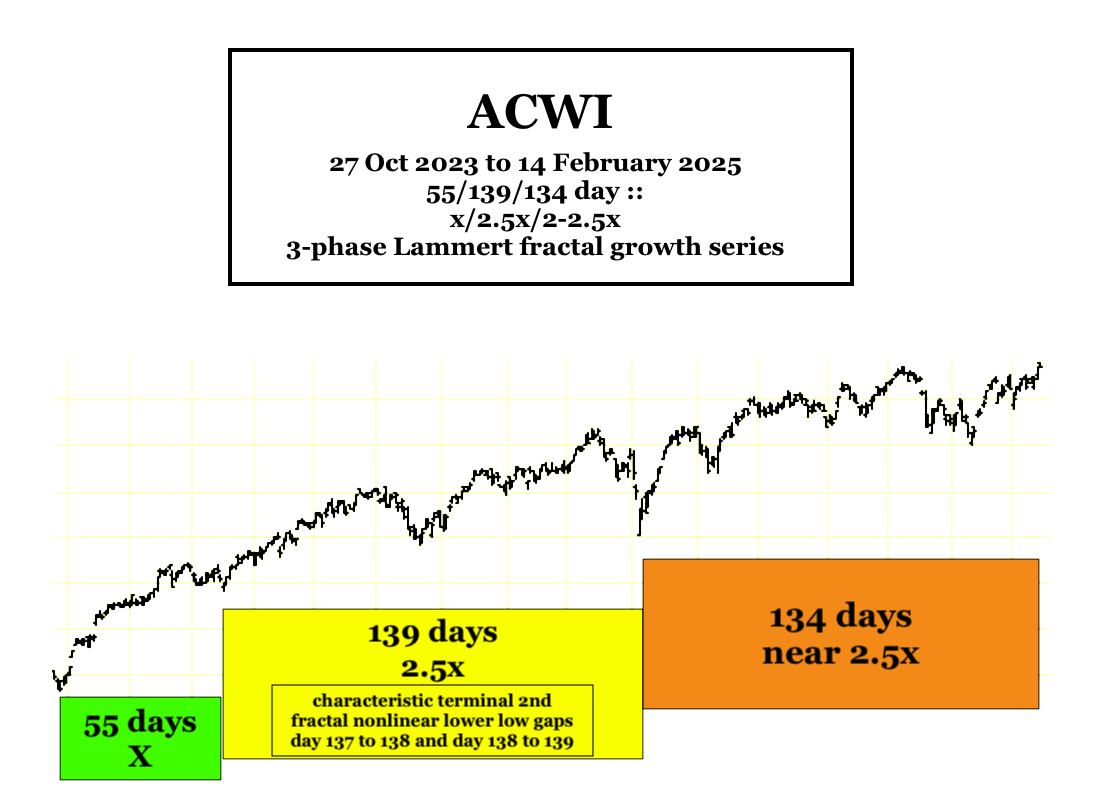
Second fractals are characterized by gapped lower low nonlinear endings in the 2x -2.5x time frame. Such a terminus can be seen in the 27 October 2023 54/139 day :: x/2.5x first and second fractal, one and two days before the second fractal ending on 5 August 2024.

The US hegemonic 90 year second fractal with its 1807 to 1842-43 36 year first fractal base and ending in 1932 had a September 3 1929 to 8 July 1932 peak to nadir length of 35 months. Based on the 0.36 ratio of the 1982 13 year first fractal to the 1807 36 year first fractal length, the decay peak to nadir ratio for the 1994 32 year second fractal is expected, by proportionality, to be 0.36 x 35 months or 12.6 months.

On 9 August 1929, a 3 phase approximate x/2x/2x initial decay fractal series of 13/27/30 days self-assembled :: with the 13 day first fractal ending on 27 August 1929. The 27 day second fractal contained the 3 Sept 1929 all time DJIA high at 381.17. The 30 day third fractal started on 2 October and ended on 13 November 1929. Crashes of 11-12 % occurred on 24 October (with an assisted recovery ending in a 2% loss ) and on 28 and 29 October, respective days 17, 19 and 20 of the 30 day third fractal. The 13/27/30 day fractal series low ended on 13 November 1929 with the DJIA at 198.60, a 52% drop from its Sept 3 high.


T

The 2024 ACWI global index daily 3 phase fractal series analogous and proportional to the 9 August 1929 13/27/30 day decay series started on 31 October 2024 with a curvi-linear 5 day first fractal and 10 day second fractal containing the 7 November 2024 gapped higher high peak ending on the high of the day, with an expected 31 October 2024 3 phase x/2x/2x :: 5/10/11 day series (if the last 11 day third fractal is proportional in length to the 1929 30 day third fractal with respect to its 13 day first fractal base). This 31 October 3-phase fractal series would end on 2 December vice 1 December 2024.

The 5 day first fractal can be better seen on the European STOXX 600 one month daily chart, which is transpiring a weakening European economy and was unaffected by the euphoria of a presidential election.
The second graph shows a ten day hourly chart with a straight tangent underlying (below the low valuations) of all intervening hours (hours 2 through 34 to 36) in the 5 day first fractal.


Of note, the ratio of the 2024 5/10/11 day or 24 day fractal series to the 1929 13/27/30 day or 68 day series is 0.353 which is within 2 % of the 0.36 ratio of the 1982 13 year first fractal length divided by the 1807 36 year first fractal length.

Finally by proportionality, what is the expected valuation peak of a second fractal with an expected 2.5x length of 32 years (1982 13/32 years) when compared to a 1842-3 to 1932 known 90 year second fractal (1807 36/90 years)and with its known valuation peak(3 Sept 1929) of 87 years? The math is simple: {(32 times 87) divided by 90}. This equals 30.93 year making the timing of the 7 November 2024 peak proportionally appropriate.

Non-Stochastic Saturation Macroeconomics